Industries Production
Shift planning for three-shift production
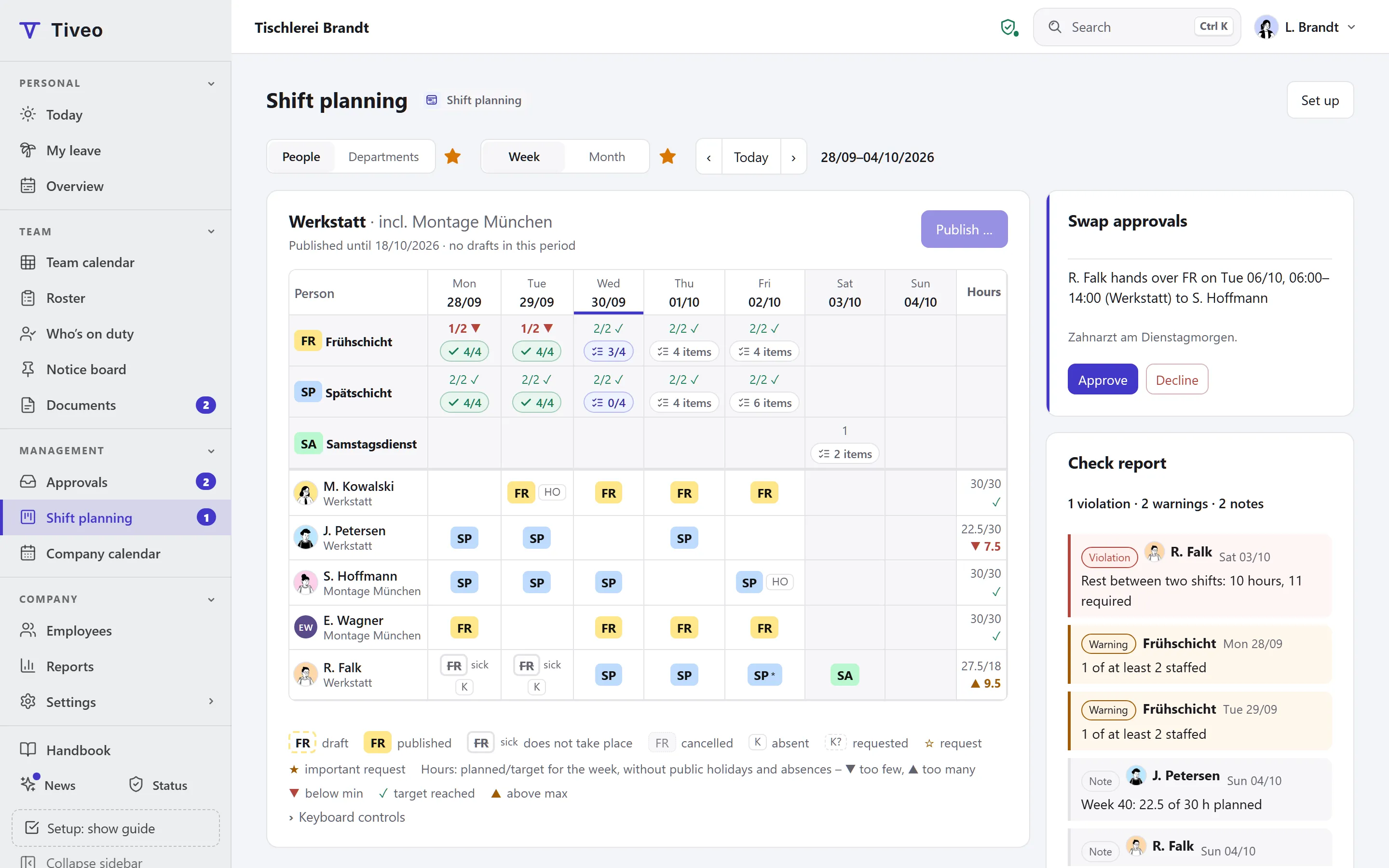
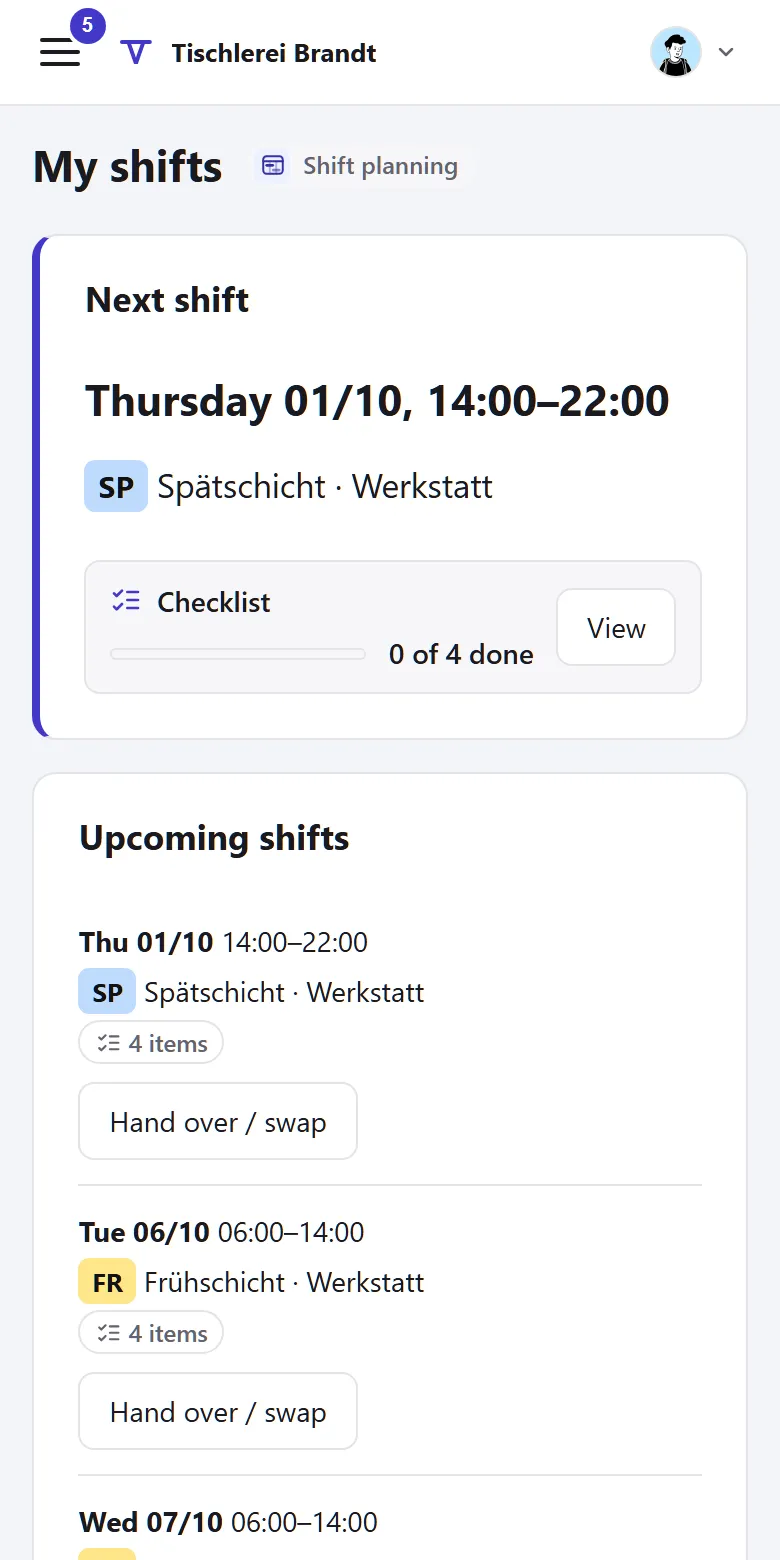
In a three-shift operation each crew follows a fixed cycle: a week of earlies, a week of lates, a week of nights. Tiveo sets it up as a pattern and produces drafts from it. Before publishing, it checks rest periods, maximum working time and nights in a row.
- The cycle as a pattern, drafts from it
- Nights in a row in the check report
- Night hours 8pm–6am and midnight–4am in the export
Recommended planning method
Fixed rotation
Everyone follows a fixed cycle; the pattern produces drafts, planners fill the gaps.
In production the cycle is agreed, often in a works agreement, and rarely changes, so nobody needs to assign it every week. A pattern applied once produces the drafts, and planners then only deal with leave, sickness and gaps.
- Requests off
- Self-scheduling off
- Open shifts on
- Fixed cycle on
- Swaps with approval
The shift model of the template
Three eight-hour shifts with a 30-minute break, rotating forward weekly (early, late, night) with two days off in between. Production stops on public holidays.
| Shift | Time | Break | Work | Demand (min · target · max) |
|---|---|---|---|---|
| Early shift | 6am–2pm | 30 min | 7.5 h | Mon–Fri: 4 · 5 · 6 |
| Late shift | 2pm–10pm | 30 min | 7.5 h | Mon–Fri: 4 · 5 · 6 |
| Night shift | 10pm–6am | 30 min | 7.5 h | Mon–Fri: 4 · 5 · 6 |
Min: below this the shift is understaffed. Target: the goal. Max: the limit up to which employees can sign up themselves.
The cycle: Three shifts, weekly forward
15 of the 21 days are working days, averaging 37.5 hours a week. The shortest rest between two duties in the cycle: 16 hours. It includes 5 nights in a row. The roster check always flags more than three night duties in a row.
You’ll find this template in Tiveo under Settings › Shift planning. It first shows what it would create: typical shift types, suggested demand, the building blocks of the planning method and, for a fixed cycle, an example pattern. It only adds what’s missing, and every setting can be changed later.
What applies in this industry
Night work has its own rules in the Working Hours Act, night premiums in tax law.
What applies, where it is written and what Tiveo does with it
-
The working time of night and shift workers must be organised according to established findings of occupational science on humane work design.
In Tiveo: More than three night duties in a row appear as a note in the check report, which with the template’s five nights means every night week.
-
Night workers are entitled to appropriate compensation, either paid days off or a premium, unless a collective agreement provides otherwise.
In Tiveo: Time recording counts the hours from 8pm to 6am and from midnight to 4am separately in the payroll export.
-
Night work premiums are tax-free up to 25 percent of the basic wage, from midnight to 4am up to 40 percent if work started before midnight.
In Tiveo: Tiveo counts the hours in these windows; your payroll calculates the amounts.
-
The works council has a say in the start and end of daily working time and its distribution over the week, which includes the shift cycle.
In Tiveo: Nobody but the planners sees drafts. The published roster is binding, and its version is kept on record.
As of 26 September 2026. These sentences summarise the legal position and are not legal advice. Collective agreements and works agreements may provide otherwise.
What you will find in Tiveo
Absences
- Leave with an eye on shift staffing
- Company holidays as mandatory leave for everyone
Time recording
- Clock in at the terminal on the shop floor
- Night shift across midnight as one working day
- Night hours 8pm–6am and midnight–4am in the payroll export
Shift planning
- Fixed rotation: the pattern produces the drafts
- Checks of rest periods, maximum working time and nights in a row
- Open shifts when someone drops out
Qualifications
- Yearly safety briefing, required for everyone or per department
- Forklift licence and first aiders as qualifications
- Medical check dates, never a finding
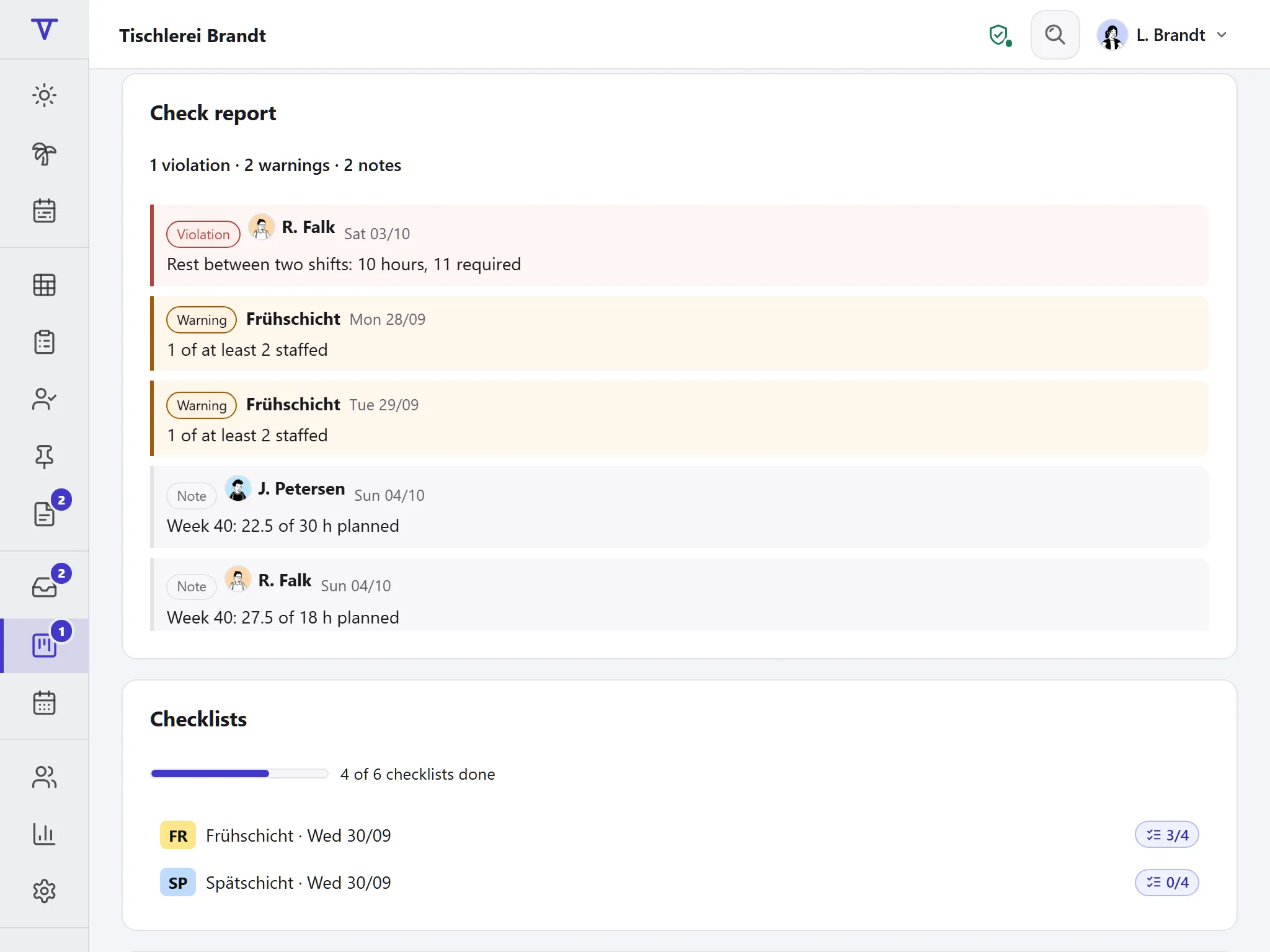
Planning needs a big screen
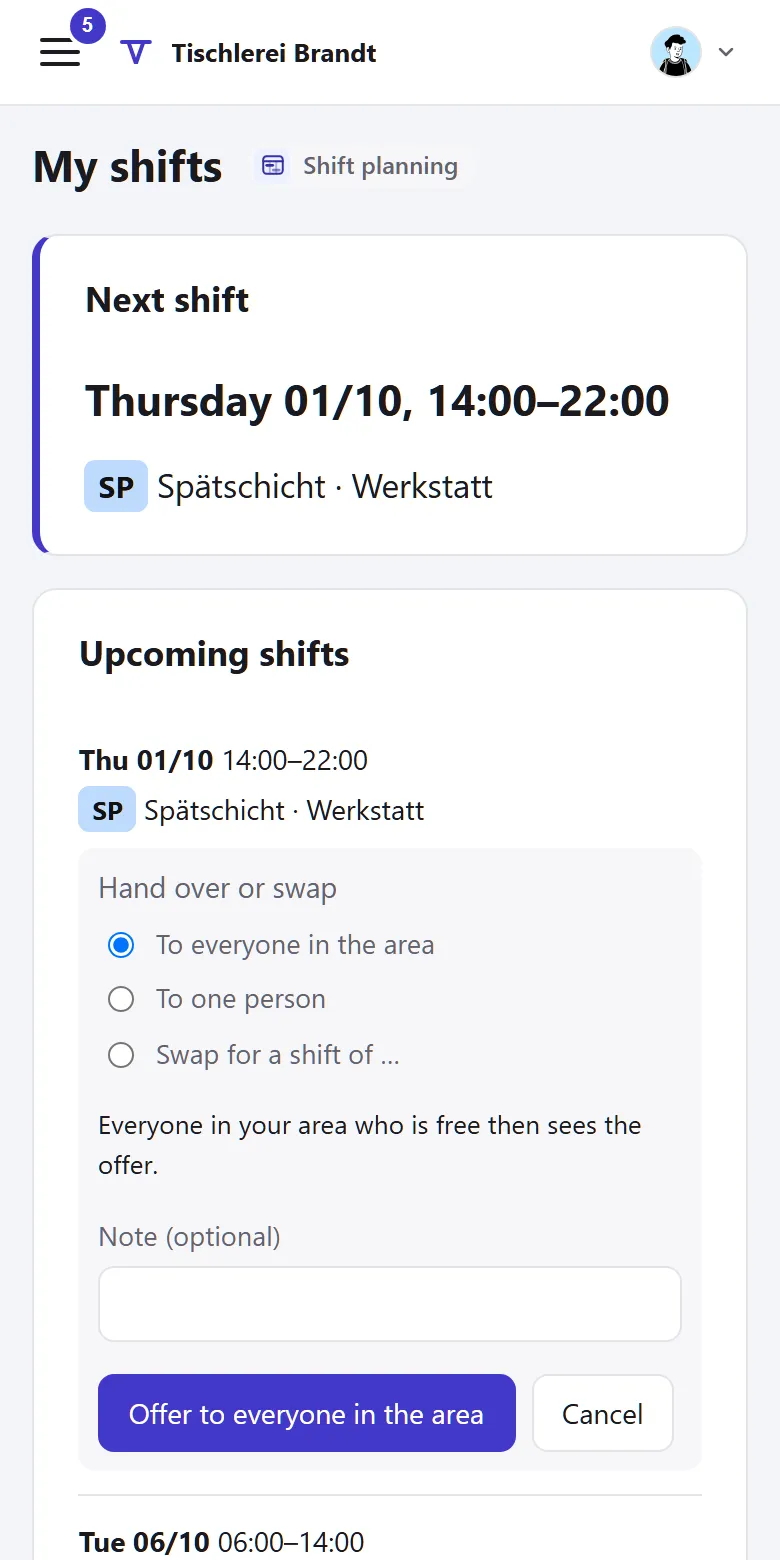
“My shifts”, swaps and open shifts fit on a phone, though.
How does the cycle get into the roster?
You set it up once as a pattern and assign people to it. The template includes “Three shifts, weekly forward” as an example. Applying the pattern produces drafts; nothing is published before the check.
Does Tiveo calculate leave based on the shift cycle?
No. In Tiveo the leave entitlement follows the weekly pattern in the person’s working time model. Whoever has more or fewer working days in the cycle sets the entitlement accordingly.
What happens on public holidays?
The template treats public holidays as days off: production stops, demand applies Monday to Friday. If you run on public holidays, you change that on the pattern.
All modules from Team
Core, absences and shift planning are included in every plan, time recording, qualifications and the vehicle logbook from Team, at no extra cost. What sets the plans apart is in the price table.
| Plan | Free | Team | Business | Company |
|---|---|---|---|---|
| Employees | up to 5 | up to 15 | up to 50 | up to 100 |
| Price per month | €0 | €19 | €59 | €119 |
| All modules | ✓ | ✓ | ✓ |
See the roster
Try the grid, demand and check report in the demo, without signing up. In your own account you choose the “Three-shift production” template.