Industries Logistics
Shift planning for warehouses and logistics
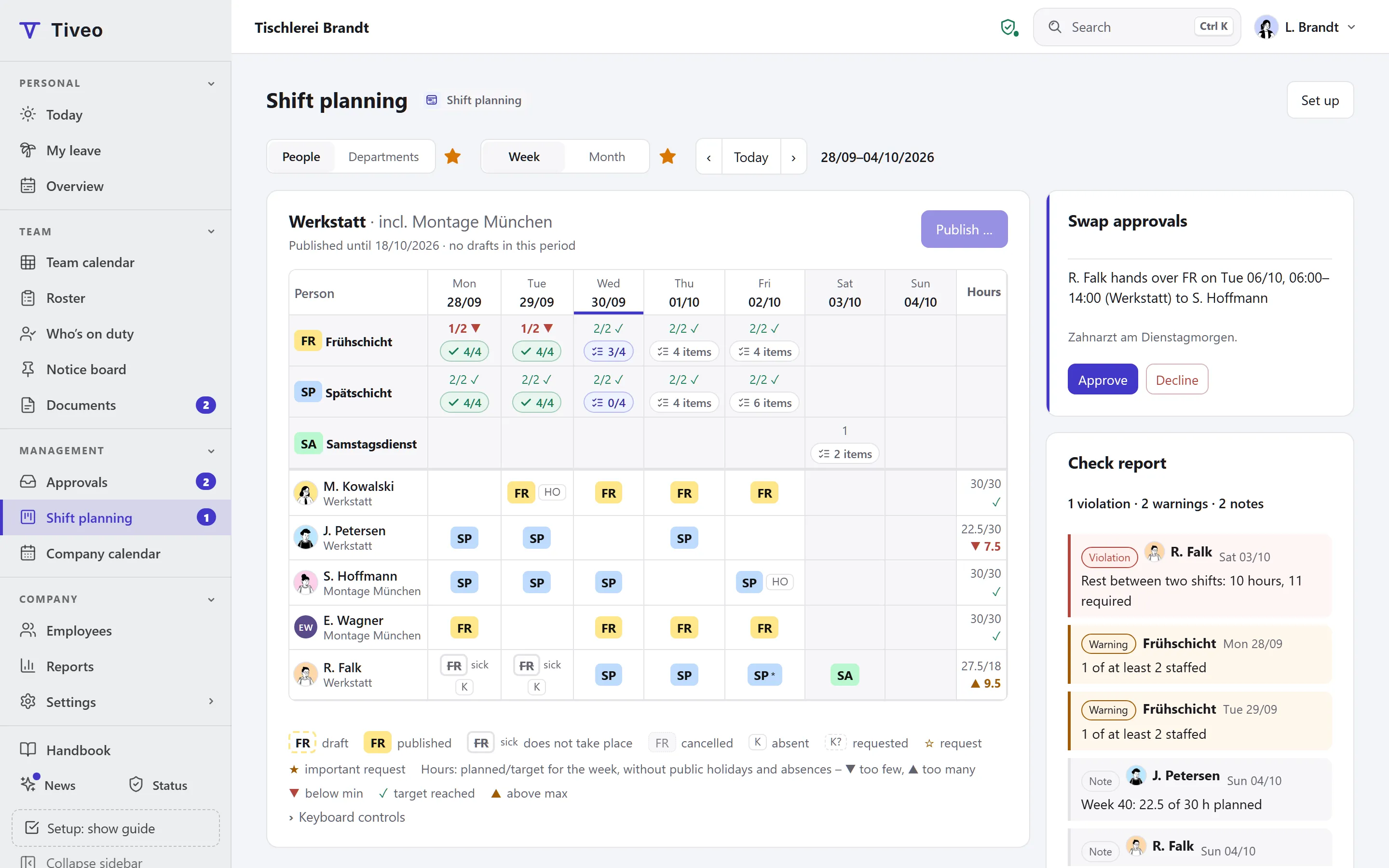
In the warehouse, early and late alternate weekly, Saturdays often come on top, and logistics falls under the extended record-keeping duty of the Minimum Wage Act. In Tiveo the cycle becomes a pattern, and you cover Saturdays through demand. Staff clock in at the terminal or on their phone.
- Early and late in weekly rotation as a pattern
- Saturday through demand
- Records within 7 days, as in § 17 MiLoG
Recommended planning method
Fixed rotation
Everyone follows a fixed cycle; the pattern produces drafts, planners fill the gaps.
Two shifts alternating weekly are a fixed cycle, and the template includes the pattern for it. Planners then only cover leave, sickness and Saturdays.
- Requests off
- Self-scheduling off
- Open shifts on
- Fixed cycle on
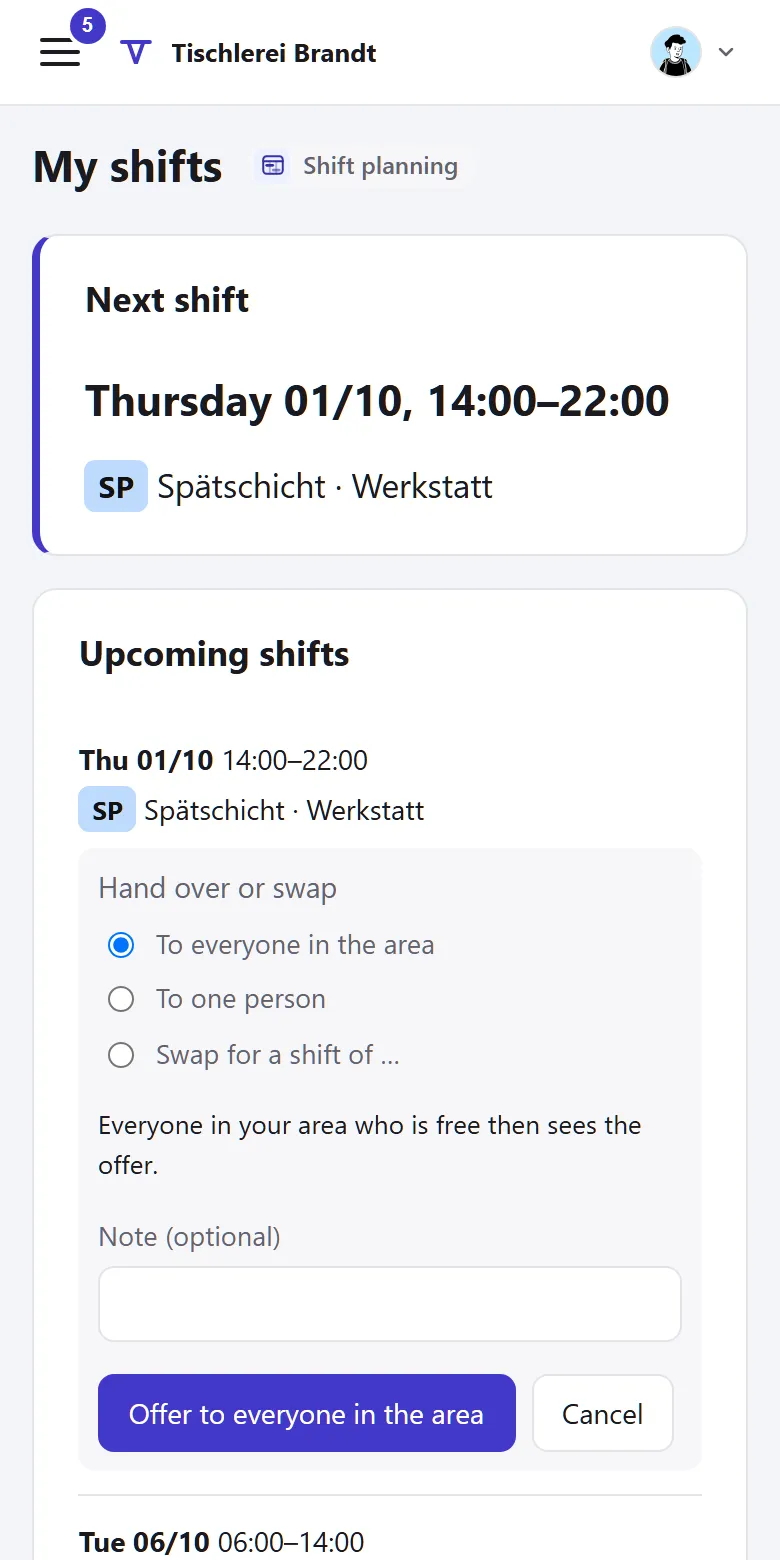
- Swaps with approval
The shift model of the template
Two eight-and-a-half-hour shifts with a 30-minute break, the late shift until 11pm. Demand runs Monday to Saturday; on public holidays operations stop.
| Shift | Time | Break | Work | Demand (min · target · max) |
|---|---|---|---|---|
| Early shift | 6am–2:30pm | 30 min | 8 h | Mon–Sat: 4 · 5 · 7 |
| Late shift | 2:30pm–11pm | 30 min | 8 h | Mon–Sat: 3 · 4 · 6 |
Min: below this the shift is understaffed. Target: the goal. Max: the limit up to which employees can sign up themselves.
The cycle: Two shifts, weekly
10 of the 14 days are working days, averaging 40 hours a week. The shortest rest between two duties in the cycle: 15.5 hours.
You’ll find this template in Tiveo under Settings › Shift planning. It first shows what it would create: typical shift types, suggested demand, the building blocks of the planning method and, for a fixed cycle, an example pattern. It only adds what’s missing, and every setting can be changed later.
What applies in this industry
Logistics has an extended record-keeping duty, and drivers have extra rules of their own.
What applies, where it is written and what Tiveo does with it
-
In the forwarding, transport and related logistics trade, the start, end and duration of daily working time must be recorded by the end of the seventh day after the work and kept for at least two years.
§ 17(1) MiLoG, § 2a SchwarzArbG
In Tiveo: The late-entry window in Tiveo is seven days by default.
-
Drivers are also subject to the driving and rest times of Regulation (EC) No 561/2006.
In Tiveo: Tiveo is no tachograph and does not check driving times. It plans and records working time on site.
-
Working time must not exceed eight hours a working day, ten hours only with compensation; Saturday counts as a working day.
In Tiveo: The template’s shifts have eight hours of work. Duties above the maximum you set (ten hours by default) appear in the check report.
-
The works council has a say in the start and end of daily working time and its distribution over the week, which includes the shift cycle.
In Tiveo: Nobody but the planners sees drafts. The published roster is binding, and its version is kept on record.
As of 26 September 2026. These sentences summarise the legal position and are not legal advice. Collective agreements and works agreements may provide otherwise.
What you will find in Tiveo
Time recording
- Clock in at the terminal by the gate
- Records within seven days after the work
- Late shift until 11pm: night hours in the payroll export
Shift planning
- Two shifts in weekly rotation as a pattern
- Saturday through demand
- Open shifts when someone drops out
Qualifications
- Forklift licence as a qualification, unlimited or with an expiry date
- Yearly safety briefing, confirmed in the app or on paper
Vehicle logbook
- Driving licence checks with a deadline: starting a trip warns or blocks
- A vehicle for each shift in the roster, with a warning if booked twice
- An unbroken odometer chain per vehicle
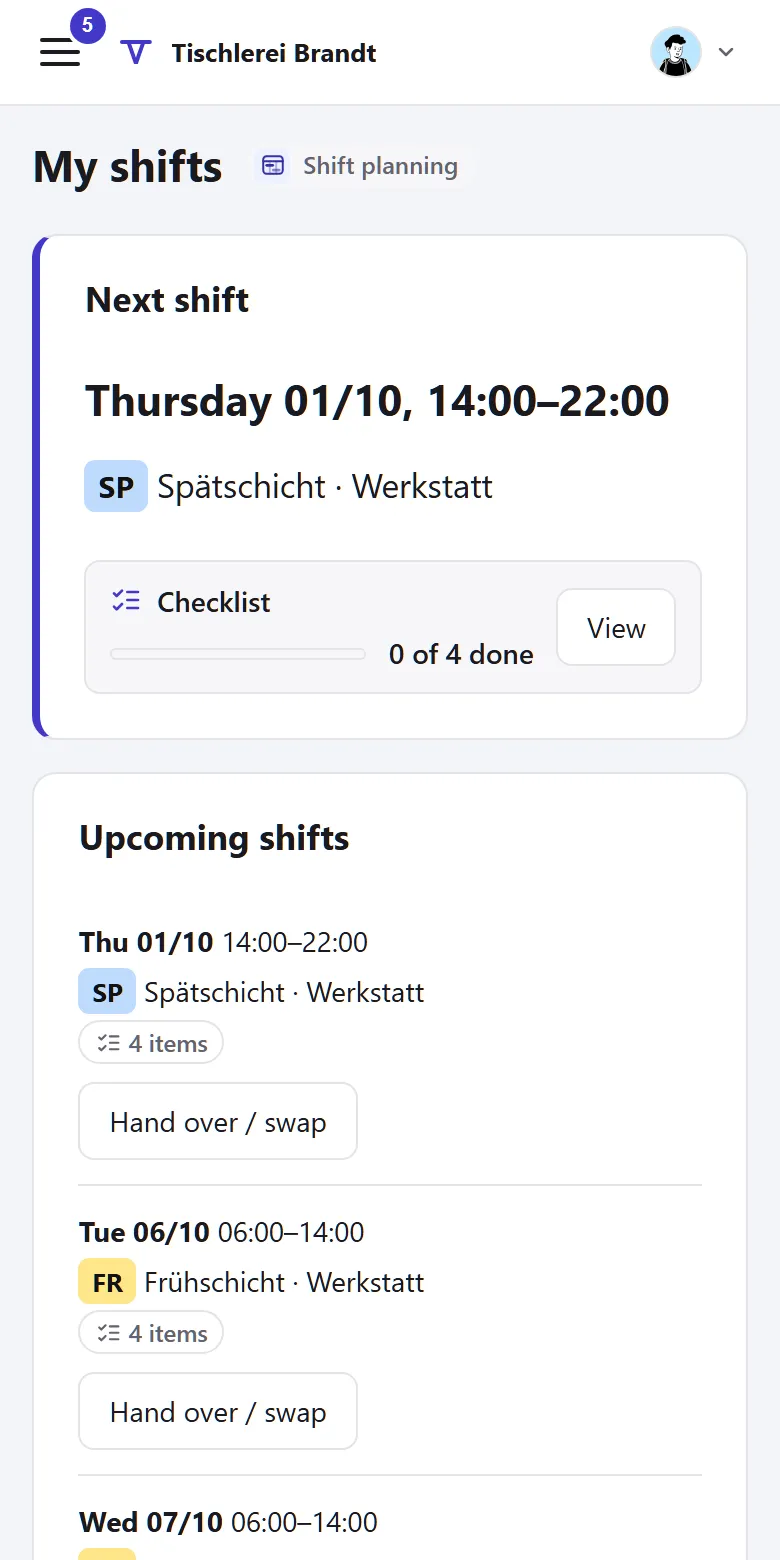
Planning needs a big screen
“My shifts”, swaps and open shifts fit on a phone, though.
Does the record-keeping duty apply to everyone in the warehouse?
In the forwarding, transport and related logistics trade, § 17 MiLoG applies: start, end and duration within seven days after the work, kept for at least two years. In Tiveo that is the default late-entry window.
Does Tiveo plan routes too?
No. Tiveo plans shifts, records working time and keeps a vehicle logbook if you wish. Routes, driving times and tachographs belong in other systems.
How does Saturday get into the roster?
Through demand: the template covers Monday to Saturday, while the cycle leaves the weekend off. Planners assign the Saturday or offer it as an open shift.
All modules from Team
Core, absences and shift planning are included in every plan, time recording, qualifications and the vehicle logbook from Team, at no extra cost. What sets the plans apart is in the price table.
| Plan | Free | Team | Business | Company |
|---|---|---|---|---|
| Employees | up to 5 | up to 15 | up to 50 | up to 100 |
| Price per month | €0 | €19 | €59 | €119 |
| All modules | ✓ | ✓ | ✓ |
See the roster
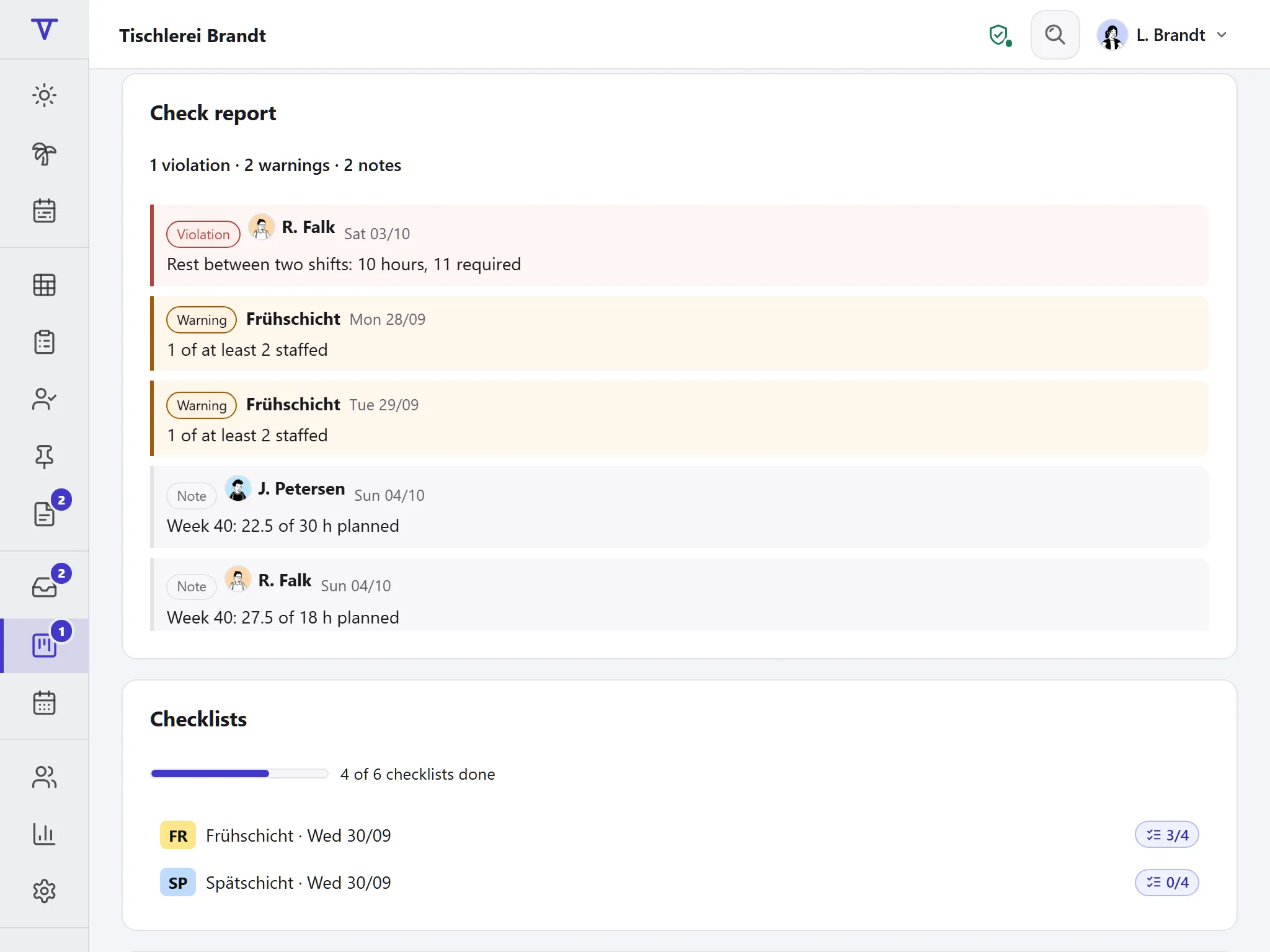
No sign-up needed: the demo shows two-shift planning with grid, demand and check report. Choose the “Logistics” template in your own account.